

“The Hearth of Auvinel glows softly, a refuge of warmth and quiet amidst the world’s chaos. Here, stories are woven like threads into the fabric of time, and the flicker of firelight holds the secrets of both the past and the yet-to-come.”
Chapter I: The Quiet Light
In a hollow of the Elderwood, where branches draped in moss sighed secrets older than stars, there lay a dwelling shaped as though the earth herself had breathed it into being. Grey stone, weathered and wise, curled upward to embrace a great arched window through which the light of the Morning and Evening passed, softer here than anywhere else in the world.
The dwelling was called Auvinel—a name lost in most tongues save those who still listened to the language of hills and streams. Auvinel was not built but grown, for here the stones spoke as kin, and the wood lent its boughs willingly to the one who had called this place “home.” And in the heart of it all burned a fire—not a small or timid flame, but one that glowed red and golden as though the sun itself had bequeathed it a part of its soul.
And in the firelight sat a keeper. Elder Ruen, he was called by those who wandered the woods and were lucky enough to find him, though many only heard of him in tales. A man who had outlasted the passing of ages, whose beard was grey and full like misty mornings, whose hands bore the strength of old craftsmen—mortal, yes, but bound to something more, something eternal.
It was said Ruen had seen the world before the shadows stretched long, before the light became veiled, before the voices of creation grew faint. In his hall of Auvinel, all things were alive. The books on the shelves murmured quietly as if they dreamed of far-off lands. The vines that wove through the stone seemed watchful, drinking in the light of fire and window. Even the air seemed to hold a memory of music—an ancient melody whose composer could only have been the Creator.
It was here that wanderers came, their feet guided by need they could not name.
Chapter II: The Stranger at the Hearth
One evening, when the twilight faded to dusk and the stars were timidly lighting their lamps, Ruen sat in his chair near the fire, his hands resting upon the great tome of Auvinel. A distant sound—soft at first, then nearer—caught his ear: footsteps. They faltered upon the stones as though uncertain of their welcome.
A knock—no more than a whisper against the wooden door.
“Enter,” said Ruen, his voice low, calm as a river that knows its way.
The door creaked inward, and there stood a stranger—a boy of no more than twenty years. His hair hung damp, his face pale as moonlight, his eyes dark and wide with questions he carried but dared not ask.
“Peace, child,” said Ruen, rising from his seat. “Come closer to the fire.”
The boy hesitated, glancing at the firelight as though he had never seen warmth before. At last, he stepped in, and Ruen could see more clearly: the boy carried with him an emptiness—not of hunger, nor of cold, but of belonging.
“You have wandered far,” Ruen said, watching him carefully. “Do you know where you are?”
“No,” said the boy. “Only that I… I was called here. A voice in the woods—or perhaps in my heart.”
At this, the old man smiled. “Then you have not been lost at all.”
Chapter III: The Speaking Stones
Over the next hours—or days, for time was a gentle guest in Auvinel—the boy was fed and warmed. Ruen did not press him for his story. Instead, he spoke of other things: of the stones beneath their feet that had once borne witness to the forging of the earth, of the fire in the hearth that had burned since the world was young.
“The fire?” the boy asked, curious at last. “What kind of flame never dies?”
Ruen’s face grew soft with wonder, as though the words he would speak were not his own but borrowed from something greater. “It is not the fire of men or elves, nor of any craft of the earth. This flame was given—breathed into being—by the One who is.”
The boy frowned, uncomprehending.
“Ah,” Ruen chuckled gently, “you think me mad, perhaps. Many do. But listen well, lad. Before all things, there was only Him—the Maker of Light, the Weaver of Time. He spoke the first words, and stars burst forth like sparks from His lips. He sang, and the earth awoke to the song. He breathed, and life was.”
The boy stared into the flame. “And this fire—”
“—is but a shadow,” Ruen said. “A reminder. For though the world has grown dim, though men have forgotten the name of their Maker, the light still calls to those with ears to hear. It is not a fire of warmth alone, but of truth, of return.”
The boy’s lips parted as though to speak, but no words came. For deep in his chest, a stirring began, like a seed that had long lain dormant beneath frost.
Chapter IV: The Stirring of Light
Days passed—or perhaps months. In Auvinel, the boy learned to tend the fire, to listen to the whispers of the stones. Slowly, the emptiness he had carried began to mend, filled with something he could not name. It was as though he was learning to remember—to see the world not with his eyes but with his soul.
And one day, as he stood by the great arched window, he saw it: a light in the woods, faint and golden as the dawn. He turned to Ruen, who watched him knowingly.
“Go to it,” Ruen said. “It calls you.”
“But—will I return?” the boy asked.
Ruen’s smile was kind. “Not here, no. But home, yes.”
For the light the boy saw was not of fire or star—it was the Maker, who called to all wanderers through the shadows of the world, beckoning them back to the place where Light and Life were whole.
Epilogue: The Fire Eternal
Years later, travelers who passed through the Elderwood told tales of Auvinel—of an old man who guarded a fire that never died, of books that spoke and walls that breathed. But no one knew what became of the boy who had wandered there.
Some said he was lost to the forest. Others claimed he had become like the stones of Auvinel: alive and eternal.
But those who truly listened, who felt the whispers of truth in their bones, knew this: The fire still burns, its glow unchanging, its warmth unyielding. And somewhere beyond the veil of stars, the Maker waits, calling every soul to come home.
For the world was made by His voice, and though the shadows may grow long, the Light shall always prevail.
Years passed, and still the tales of Auvinel spread on quiet lips. They were carried by wanderers, by pilgrims, by those who had felt the stirring of light in their hearts—soft as a whisper, deep as a root. None could say where the old hall stood, for it was said that Auvinel appeared only to those whose souls were weary yet willing, who longed for something more than earthbound life could offer.
But on rare nights—nights when the stars seemed brighter and the air rang with a stillness too perfect to be ordinary—some claimed they saw it. In the distance, through shadow and bough, a light glowed golden and sure, a flame steady against the dark.
It was not the fire of men. It did not crackle or burn as the fires of this world do, for it was not of this world. It called. It called as a voice familiar and yet forgotten, a voice that spoke to the innermost parts of a soul, saying:
“Come, child. Come home.”
And those who heard it knew that they were not lost. They were found.
For the light at the edge of the wood was not a fire to be feared, but the fire of love everlasting, the fire of the One who sees and knows—who has always seen and known—and who waits with outstretched arms. He waits as the Keeper of Time, the Maker of Life, the one who forged the stars and planted the seeds of longing deep within every heart.
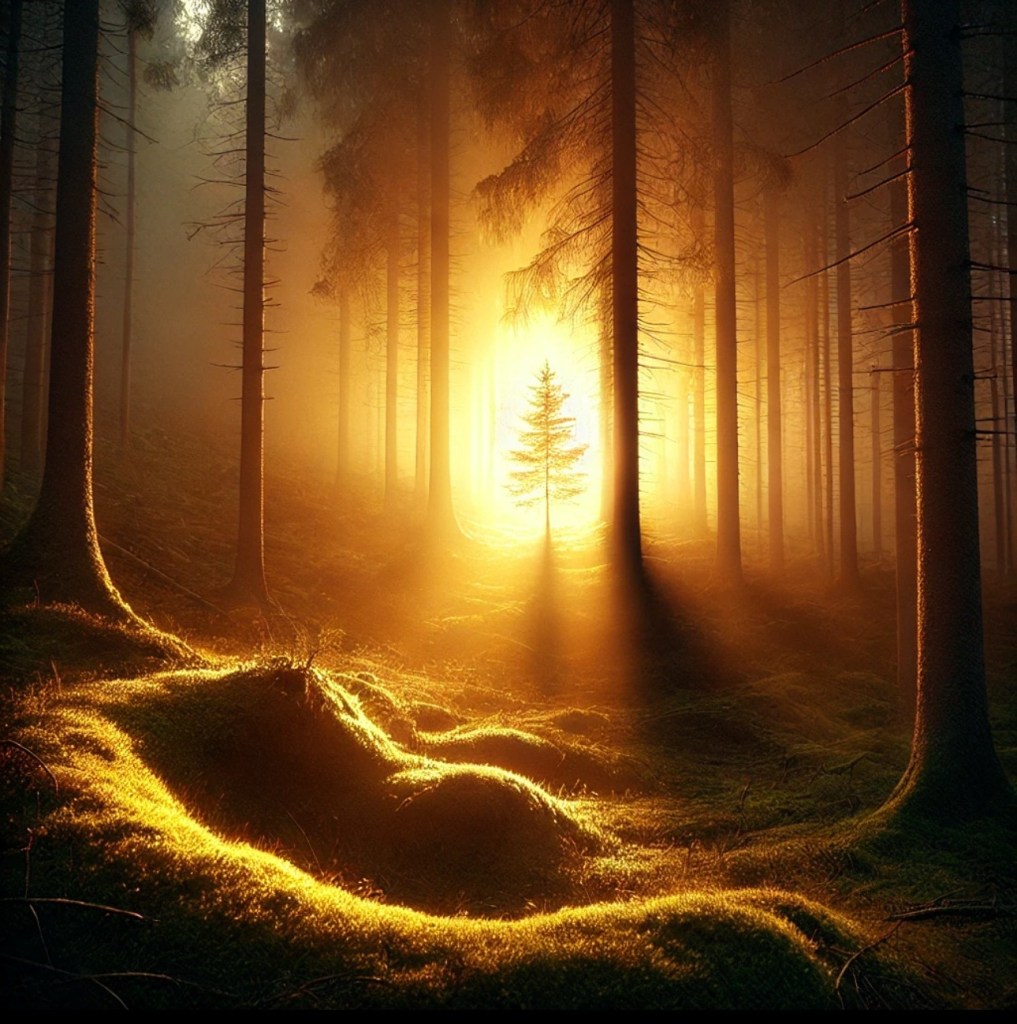
And to those who turned toward the light, the shadows lost their strength. The wanderers became pilgrims, their steps lighter with every mile. They knew now, as Elder Ruen had said, that this world is but a shadowed hall, a place of learning and longing, a foretaste of the greater joy to come.
For the fire burns still. It will always burn, a beacon for those who wander in darkness, a flame that whispers of a home where every tear will be wiped away, where every longing will be met, and where the Maker’s light will shine brighter than the first dawn.
And on that day, when all is made new, the voice will no longer be distant or faint. It will fill the heavens and the earth, and it will speak these words to every heart that dared to listen, every soul that turned toward the light:
“Well done, my child. Welcome home.”
The End
Chrysi
.
This story is protected by copyright and all rights are reserved. No part of this work may be reproduced, distributed, or transmitted in any form or by any means, electronic or mechanical, including photocopying, recording, or by any information storage and retrieval system, without the express written permission of the author.
©️ 2024 Christina Whalen
 Field Notes of a Wanderer
Leave a comment