“The human heart is the first home of democracy. It is where we embrace our questions: Can we be equitable? Can we be generous? Can we listen with our whole being… and do we have enough resolve in our hearts to act courageously, without giving up—ever—trusting our fellow citizens in the determined pursuit of a living democracy?”
—Terry Tempest Williams
I write this from the edge of the Cumberland River, where her waters still shimmer like memory.
I walk these streets of Clarksville, Tennessee, listening for birdsong and silence—measuring what we have kept and what we have lost.
This is where I live now. But my home—my first memory, my first cry, my soul’s soil—will always be Lancaster, Kentucky.
Foothills of the Appalachian Mountains.
Where the land rolls like a hymn.
Where barn swallows carve the air like cursive.
Where I skipped rocks on creeks lined with limestone and learned the names of trees before I knew how to write.
I’ve lived in Louisville—its concrete heart, its river-bound ache.
I’ve walked its back alleys and watched pigeons rise through steam like prayers.
I’ve known the quiet, fertile hum of Glasgow and the slow breath of Horse Cave and Cave City—lands where the underground world echoes with the songs of hidden water and unseen bats.
And for a time, I lived in Saint Augustine, Florida—where the salt air carries the ghosts of the oldest city in the nation.
Where the sea turtles still struggle to nest under the glow of artificial lights.
Where manatees, gentle and slow, are struck by propellers in waters they have known for centuries.
Where the marshlands are shrinking, and the roseate spoonbill searches for safe haven amidst development and saltwater intrusion.
Where hurricanes swell stronger each year, reshaping the coast and sending shorebirds inland in disoriented flight.
I loved the ocean there—but I grieved it too.
But it is here, in Clarksville, where I now watch a different kind of transformation.
Not the good kind.
The kind where the topsoil is scraped away, and what was once meadow is now a subdivision.
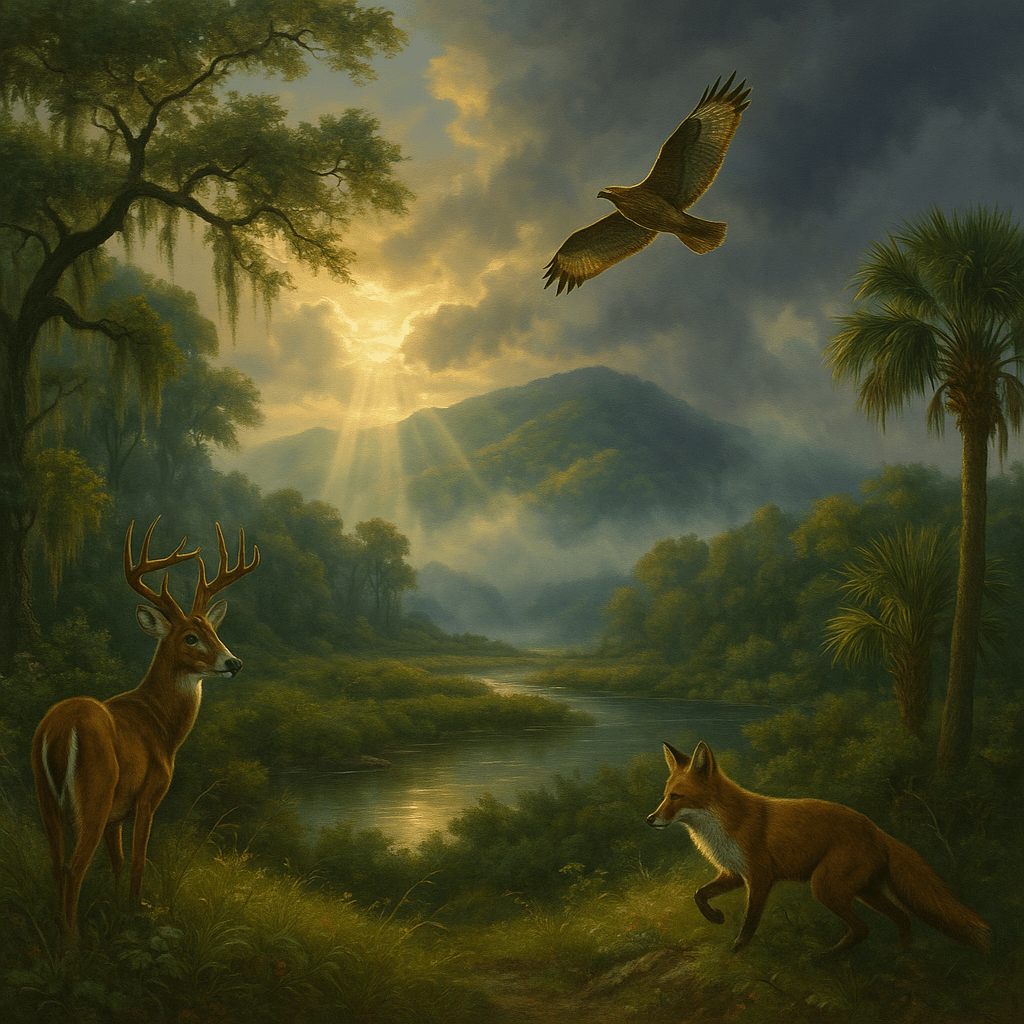
Where the trees fall, and the deer run bewildered through backyards, trying to remember where the woods went.
Where the light pollution blinds the stars.
Where industry swells but the rivers shrink.
The Earth is not just suffering.
She is calling out.
Microplastics glint along the shoreline like broken promises.
Construction booms echo louder than birdsong.
We pave paradise and call it progress.
And the wild things retreat.
Not because they want to.
But because we’ve given them no choice.
Here in Montgomery County, Tennessee:
The gray bat, once thick in our skies, is slipping toward absence. The streamside salamander, native to these waters, vanishes with every culvert and spill. The eastern meadowlark, a bird of open fields, has fewer fields to sing in. Coyotes cry louder now—not out of wildness, but confusion. And the black bear, once rare, begins to roam again—disoriented, hungry, crossing interstates like borders they never agreed to.
And yet—the insects still sing as they float downriver.
I think of Issa’s haiku.
How even in the face of uncertainty, nature persists in praise.
Insects on a bough
floating downriver,
still singing.
This is our charge.
Not to control.
But to accompany.
To witness.
To listen.
My Cherokee blood remembers this.
We were never meant to conquer the land.
We were shaped to be in relationship with it.
To protect it.
To love it fiercely.
God did not give us dominion as a license to destroy.
He gave it to us as a call to steward.
To kneel before creation in reverence and say, “I will not turn away. I will not numb myself. I will not forget what you have given.”
And one day soon—when the road curves right and the Spirit says now—I hope to return to Glasgow.
To that tender patch of Kentucky soil where I can feel both rooted and free.
Where the cedar waxwings gather in late winter, and the monarchs pass through like painted prayers.
Where the land still remembers who she is.
And maybe I’ll raise a small garden.
Hang a bluebird house from the porch.
Leave out seed for the goldfinch.
Walk the land barefoot until I remember I belong to it.
Until I stop longing for elsewhere, because this place becomes my vow.
We are all called to be keepers of the wild.
Whether in the Appalachian hills or on the banks of the Cumberland.
Whether surrounded by horses or high rises.
It is not too late—
but we are out of excuses.
So today,
I put my ear to the earth.
I listen for what is left.
And I write.
Not because it changes the world—
but because it reminds me I am still a part of it.
May we never grow too civilized to weep for the meadowlark.
May we never grow too numb to pray for the salamander.
May we never grow too distracted to remember the land that made us.
This is my prayer.
This is my offering.
This is my vow.
cm.w
©️2025 Christina Whalen
All right reserved.
 Field Notes of a Wanderer
Leave a comment